[ESC] Testing A New Habitat
The zoo was getting rhinos for the first time, and the preparations were intense.
After a long time of planning and negotiations, they were slated to recieve two white rhinos; a female from a safari park across the country and a male from a zoo in the next state over.
Of course, before they could recieve their new residents, they had to prepare a suitible habitat for them to live.
The zoo primarily housed savannah hoofstock, with nice "display" habitats up front in easy view of the guests, and spacious off-display pastures in the back that animals could be rotated through for enrichment and to allow the grass to recover from grazing. All were lined with tall fencing, as many of the hoofstock species had no trouble leaping over a six foot fence. Though the hoofstock needed a tall fence, they were sufficiently contained with chain link or wood. A rhino would not be.
Similairly, the barn in each habitat that allowed animals to be securely housed in case of a storm or seperated for observation in case of medical need was built of wood or aluminum. A rhino would view those walls as little more than a suggestion.
The grand plan was to house the rhinos in a mixed species savannah exhibit (with plenty of space and escape routes for the herbivores who might be nervous of a nearby rhino). For this, they converted the previous savannah display exhibit to be rhino-proofed. Conviniently, it already had a few steep rock walls that a rhino wouldn't be able to barrel through. Some steep drop-offs had to smoothed out or blocked off with bollards and logs, as the hoofstock were a bit more nimble than the rhinos would be and no one wanted the new residents to take a tumble and injure themselves. (When you weigh as much as a rhino, a fall is no laughing matter.) More visual barriers were added in for a sense of security.
The wood fence that stood under the raised viewing platform was replaced with concrete. The exterior walls were raised and reinforced. Chain link was replaced with steel panels and gates on a sliding track, and a hidden second gate was added in the middle of the exhibit behind a faux rock formation to allow the habitat to be seperated into two if needed.
A seperate, second barn was built just for the rhinos. With expansion in mind, they left space for six animals and not just the two they expected. It was built with steel bollards and concrete, with spaces for veternary work, and a scale big enough to weigh an adult rhino.
For the duration of construction, the savannah animals were moved to one of the off-display pastures. The change didn't bother them, since they were used to rotating through the pastures with the seasons anyway. The kudus did not care for the loud construction noises, making them skiddish, but mostly they adapted just fine.
Finally it was time for a test run. Before the construction, the Masai and Acacia animals had rotated through the display habitat. If they all got along well with the rhinos without too much stress, they would continue to do the same.
Human keepers walked the space first, looking for anything they thought might be questionable. They would of course be looking for any sorts of things they had seen lead to an escape before. A few small things were pointed out, but since they had been watching the construction and providing feedback along the way there wasn't much left to patch up.
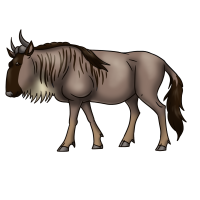
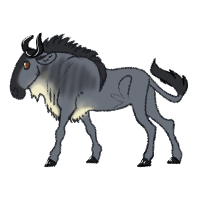
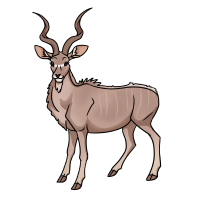
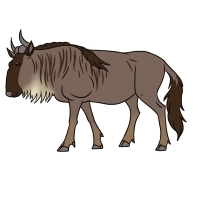
It was the kudus and wildebeest who were brought in for the initial animal test. They were cautious and curious, but were also reasonably easy to herd in one direction or another if they needed to be removed in a hurry.
Cliff the male kudu was the boldest, leading his ladies around in an inspection of the space and the changes to it. His gait was a high stepping walk, impressive and graceful. His neck was thick, holding up his heavy horns, but he carried it proudly. He spent some time licking and sniffing the concrete fence. Keeper Steve was worried he might try to ram the fence to test its strength, but for once Cliff seemed to have more sense than that. The bull did steer clear of all the trees with branches at his eye level as he made his circuit. He had learned how to navigate the space with his impressive spiraling horns, and didn't take any chances of getting snagged in a tree. His ladies had no such problem, and pushed forward to nibble on the new leaf growth on the trees, large cupped ears swiveling to listen for danger.
Bert and his girls Bleu and Brie stayed in the lower, open half of the habitat for a long moment, surveying the area with tails swishing nervously. While the kudus would fan out in the shade of the trees, the wildebeests usually clumped together for security, grunting to each other for reassurance.
As prey animals, kudu and wildebeests did not like being taken by surprise. They spent the afternoon carefully peering around any corner that something could be hiding behind. It did not take them long to find the new grass and plants that had grown up while the yard was uninhabited for construction, though the food did not stop them from being wary of their changed surroundings.
At dinner time, when the animals would typically be moved into their barn for the night, Steve shifted the kudus into their old barn and the wildebeests into the new rhino barn. Bert didn't like this, and stood for several minutes barking into the empty doorway of the rhino barn before he and the girls cautiously toed their way inside. His long mane bristled and he lashed his long tail in an anxious display. He stamped his hard hooves on the way in, ringing a different sound as he crossed from the loose dirt of the habitat to the concrete foundation to the sand interiour.
The rhino barn had sand floors, two large communal stalls and six smaller stalls where individual rhinos could be held seperately. All the gates had been left open so the wildebeests could explore the space. As a grassland species, the wildebeests didn't care for being trapped or confined where they couldn't run away if they were spooked. Predictably, they stayed in the larger of the communal spaces where they could keep an eye on everything going on around them.
Steve was posted to keep an eye on them overnight, since it was new space for them and was still being tested.
Wildebeests don't spend much time sleeping, usually nodding off for less than an hour. It was all a part of living in a wide open grassland where predators could sneak up on you at any time. Even being housed in a barn at night didn't releave them of that habit.
Steve was begining to doze off when a clanging noise snapped him back awake.
Bert vocalized loudly, crinkling his large nose as he did. All of his whiskers did a bit of a dance as he called. Steve saw Brie beside Bert, but couldn't see Bleu.
Bleu was the youngest of the wildebeests, and the most curious. It made her a crowd-favorite, as she was the most likely to play or investigate enrichment. It seemed that tendency had come through again here, as her tighly curved horns rang out against steel from somewhere in the barn.
Steve hurried to check where she had gone and quickly found her. She had wedged her way through one of the holes built into the steel-barred wall of a stall for training and procedures like ultrasounds or blood draws, and into the chute with the scale. She wasn't tightly stuck, but the nervous tossing of her head was causing her horns to snag on the bars and she danced in fear, able to figure out the way back through.
"Easy, easy," Steve told her. Luckily he had worked on training with her before. He hoped that would make this easier. He grabbed a pole used for target training and lightly tapped it to her face. Instantly she stopped dancing and focused on him, though her legs still quavered with stress and uncertainty. Slowly Steve opened a human-sized gate in the barrier and used the target to lead her back through to the communal stall. It took many moments and a lot of reassurance but she went through, and got a herbivore biscuit one she was through the other side.
Brie, the lightest of the herd, greeted her with grunts and foot stamps. She was the smallest and most nervous of the herd, and always the most eager to keep the herd togther. Brie and Bleu exchanged sniffs and calmed considerably, as Bert continued vocalizing softly to them.
With the wildebeests secured, Steve looked over the slot in the barrier and blocked it off with a piece of plywood. He would bring it up tomorrow so they could find a fix; perhaps a hinged cover for it. If a wildebeest could wiggle through it, a curious an energetic baby rhino could do the same in the future if they were ever so blessed.
The next morning, he released the kudus and wildebeests back into the display habitat. They made the rounds, but in their normal daily inspection and not in the way of investigating a totally new space. No fences had been leaped or knocked over. The test was off to a good start.

You have to test a new habitat and make sure it is escape proof before you put rhinos in it! You do not want to be chasing down an escaped rhino if you skip this step.
Submitted By bovidaeloony
for The Great Escape
・ View Favorites
Submitted: 3 months ago ・
Last Updated: 3 months ago