Species
Bighorn Sheep
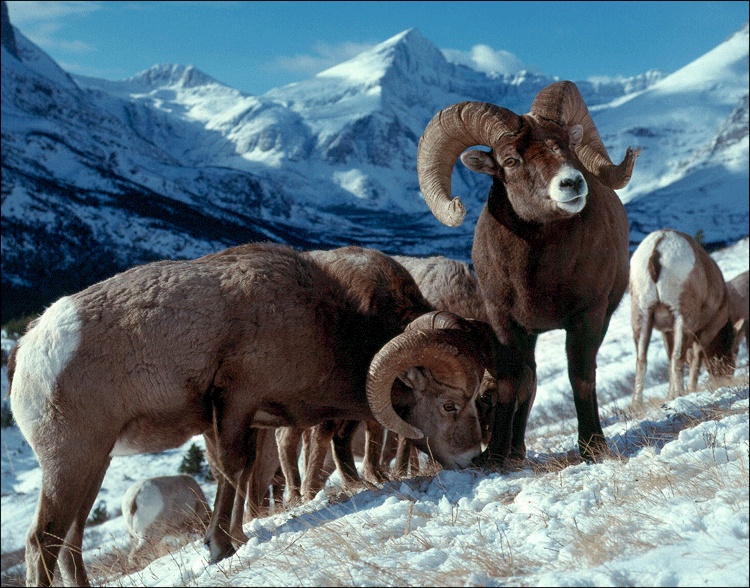
By Kim Keating, USGS photo - Archived source link at USGS, CC BY 3.0, https://commons.wikimedia.org/w/index.php?curid=6144112
Ovis Canadensis
Bighorn shaep, named for their large horns, are sheep native to North America. They are lighbrown to grey or dark brown with a white rump. There is extreme sexual dimorphism, with males having large, curved horns and females having short, straight horns. Males are also substantially larger with large horn cores, sinuses and internal adaptations to protect the brain by absorbing clash impact. There are three recognized subspecies: Rocky Mountain, Desert and Sierra Nevada.
Range: There are three recognized subspecies. Bighorn sheep range from the Rocky Mountains from southern Canada to Colorado, Nevada, California, west Texas and Mexico.
Sociality: Herds ranging from 8 to 10 to around 100; sexes form separate herds
Habitat: Alpine meadows, grassy mountain slopes and foothill country. These sheep prefer drier slopes with little snow.
Size: 53-127 kg (116.74 to 279.74 lb); 150-180 cm (59.06 to 70.87 in)
Life Span: 6-15 years in the wild; up to 19 years in captivity
Feeding: Herbivore.
Reproduction: Polygynous. Sexual maturity for females are reached at 2-3 years and males reach sexual maturity at 7 years. Horn size and mass of horns are a symbol of rank with males engaging in battles over mating access for each females. Rutting season occurs in autumn and early winter with births taking place in the spring. Gestation is 150-180 days with one, ocassionally, two lambs born. Lambs are weaned by 4 to 6 months.
Conservation Status: Least concern. Readily adapt to captivity.
-------------------------------------------------------------------------------------------------
Full Classification:
| Kingdom: | Animalia |
| Phylum: | Chordata |
| Class: | Mammalia |
| Order: | Artiodactyla |
| Family: | Bovidae |
| Genus: | Ovis |
| Species: | O. canadensis |